 Case 02 · Perfume & Beauty · Switzerland
A margin system that steers every ad franc toward profit.
Automated repricing plus a Google Ads system that steers every product by real contribution margin, not by revenue.
XXL-Parfum.ch is a Swiss perfume discounter with over 7'500 fragrances. In this model, the contribution margin per sale decides, not revenue. I gave the business a margin system that steers every product by real profit and channels the ad budget to where the most contribution margin is generated.
Starting point
XXL-Parfum sells brand-name perfumes below RRP, with tight margins in the Swiss market. The market is fiercely competitive: many sellers carry the same brands and compete almost solely on price, every rappen of margin counts. A new owner took over the business, aiming to rebuild it profitably. The existing Google Ads account had not been modernised for years and was losing efficiency.
Challenge
In a price-discounter model, contribution margin decides, not revenue. Two equally expensive sales can be completely differently profitable, depending on how cheaply the product was purchased. An ad account that simply optimises for revenue treats both the same and leaves profit on the table. At the same time, click prices at Google keep rising and press on the already thin margins. The task was to steer the budget not by revenue, but by real profit per product.
Approach
First I built the foundation: automated repricing that calculates the break-even price for every product from all real costs (purchase, allocated fixed costs, shipping, returns and target profit) and continuously adjusts the selling price to the competition without sacrificing margin. This gave the entire company a technical core that steers profitability. I translated that core into marketing: every product is scored on four factors, and the ad budget automatically flows to where the most contribution margin is generated per sale.
How the system calculates in detail
- Break-even price per product: from six cost blocks plus target profit, i.e. cost of goods, direct variable costs, returns, write-offs, allocated fixed costs and order costs.
- Repricing: adjusts the selling price daily to the cheapest competition, but never below the break-even price. The gap between selling price and break-even price is the margin available for marketing.
- Scoring: every product gets a rating from margin and competitive position.
- Steering: the rating flows automatically and daily into the product feed and into margin-aware Performance Max campaigns, the budget follows contribution margin instead of revenue.
Results
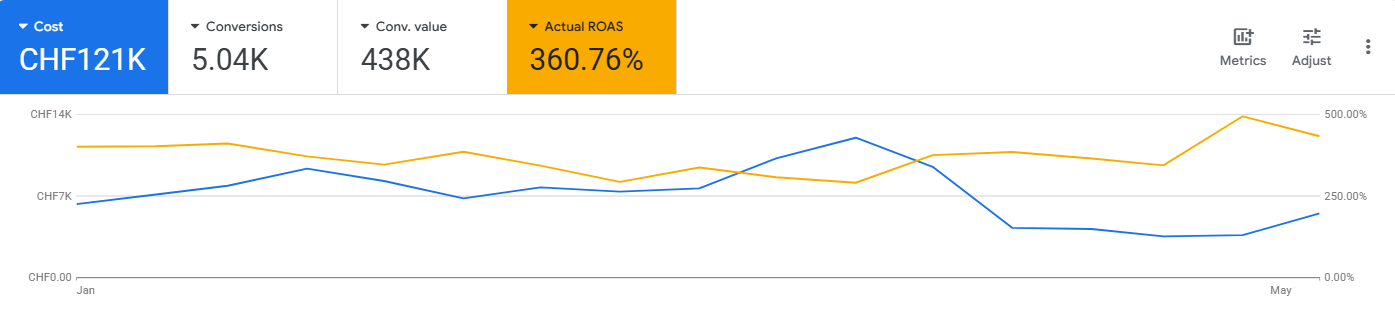
The ad budget now follows profit, not revenue. The effect shows first in profitability: the marketing contribution margin rose by around 20%. This improvement sits in purchasing and product selection and cannot be read off revenue or ROAS alone, it is the actual core. It also becomes visible in the ROAS: after the rebuild it sits clearly above the profitability threshold of 310%, in the months after between 419% and 494%, instead of partly below.
“Stefan understands his craft like a Swiss watchmaker. That is the best way to describe his work on our Google Ads account: structured, thoughtful, and with an unfailing sense for how things connect. He is technically skilled, delivers every data analysis we ask for, and always brings helpful insights. Motivated, open to new approaches, and simply a really pleasant guy.”
Matthias Lehmann, Owner of XXL-Parfum.ch
Your shop could be the next case.
Get a free audit